Changing the Response to Conditioned Weight Bias

Complete these sentences with the first thing that comes to mind,

Mary had a little ____

Twinkle, twinkle little ____

Don’t cry over spilled____

Chances are your answers were lamb, star and milk. Chances are you didn’t have to think too hard, or select these responses, but rather they just popped into your head. These are responses that you have been conditioned to give after you have probably heard the rhymes or statement many times throughout your life. What if some of the thoughts we have are just like your responses to the sentence completion task? That they exist because you have heard them over and over again throughout your life.

Many of the thoughts we have are conditioned responses in that they are learned responses to a particular stimuli. We have learned the response from direct experience and/or we have witnessed the response.

Applying this to the body, we can see that we have been conditioned to have certain responses to different sized bodies. I grew up in the 80’s and 90’s. A time when being waif thin or heroin chic was idealized. A time when you didn’t see much body diversity on the screens. When larger characters were on screen they were typically laughed at or looked at with disgust. Fat suits were used to create characters that people would laugh at. They were portrayed as lazy, unintelligent, and unlovable.

With the rise in panic over the “obesity epidemic”, health increasingly became tied to the body. Heroin chic moved aside for thin/fit physique to take place as the ideal to strive for. People in larger bodies were gracing our screens more often, but now they were unhealthy beings that needed to be “fixed” in order to be happy and live a normal life.

And that is just what was unfolding in general discourse and media, nothing to mention of what was happening in people’s homes, the school yard, or the workplace. Where further conversations and actions about weight and body were also occurring. What we learned in all this was that thin/fit is good, and fat is bad. As a result of this learning, we are conditioned to respond to our own and other peoples bodies. We have been conditioned to have weight bias and body image struggles.

Weight bias is “the negative weight related attitudes , beliefs and assumptions towards people who are fat”. When it impacts our actions, and we change how we respond to another it becomes weight discrimination. When we respond to our own body with the judgments it is internalized weight stigma.

It is detrimental to our health. You thought the “obesity epidemic” was bad, well the epidemic of weight bias and discrimination is worse. Unlike other forms of discrimination that are on the decrease, weight discrimination is on the increase. People in larger bodies encounter it from a young age, and it continues with them throughout the lifespan. From being picked on, teased and ostracized from the other children, to being overlooked for promotions, teased by partners, family and friends, and to having to fight for basic health care and to be seen and heard. Being constantly judged and attacked across the lifespan puts the body in a state of stress, which takes its toll physically. Impacting many systems. The poor health that many attribute to a person being fat and the assumption of an unhealthy lifestyle, is often related to the impact of prolonged discrimination and issues with accessing health care. Not to mention the negative impact of weight bias and discrimination on mental health. The weight bias and weight discrimination epidemic is the one we need to address, not the “obesity epidemic”

Some people cry out in protest, claiming that people need to be shamed in order to motivate them to live a healthier lifestyle. We have learned long ago that shaming is an ineffective way of creating change. Not only is it ineffective, it often creates more harm. Those who are shamed in relation to their body feel less motivated to engage in physical activity. Shame is NOT a motivator.

The weight bias thoughts we have are a product of our conditioning. They may continue to pop into our heads, just like the words in the sentence completion task, but that doesn’t mean we have to believe them or act on them. We have the power to choose what we do. Whether we want to be a slave to our old conditioning, or if we want to form new pathways and new conditioning.

The first step building awareness. Notice the thoughts that come to your mind. Notice when you may react differently based on a person’s size. You may be surprised just how much your conditioning appears.

As you notice, pause and ask “Is this helpful?”. If believing the conditioned response leads you to make assumptions and to treat someone differently because of their size, then the answer is no. Weight stigma and discrimination impacts people’s physical and mental health in a negative way.

Instead, treat people in a way that is consistent with your values. How do you want to treat people? How do you want people to feel when they are around you? That is a more helpful guide for how to treat other people than their weight. Add a new conditioning, value based interaction.

When talking about weight bias and discrimination I draw attention to our conditioning, not to justify the actions we take or have taken, but rather to take the shame out of them. We don’t like to feel shame. We try to avoid it. This can lead to avoiding looking at things that need to be changed. By acknowledging the conditioning, attention is draw to how the thoughts and behaviours are not helpful (as opposed to labelling the thoughts or the person as “bad”), and in doing so it is easier to look at and change that which is an unhelpful.

Change isn’t easy, but it is possible. Let’s break free of our unhelpful conditioning.

Everyday values

I love doing values work in therapy. No matter which way I approach it I enjoy it. I enjoy seeing peoples eyes light up as they identify and connect with what is important to them.

Values are what is deeply important to you. They give life meaning, purpose, direction and vitality. They are different to goals, in that they are not something that can be achieved and ticked off a list. They are ongoing. Examples include, kindness, compassion, curiosity, openness, adventure, honesty, humor.

Yet doing values work is not without its struggles.

Common traps

  • Following my values will always feel good. Sometimes value based actions feels good, but sometimes we have to do hard or scary things in order to move towards our values. Thus, value based actions don’t always feel good. Also, values are what is important to us. They are what we care about. When we care about things, we feel. When we feel connected to our values we may experience more pleasurable feelings, but when we are disconnected from our values or they are threatened, less pleasurable values will likely be experienced.
  • I “should” value…. Sometimes when talking about values people talk about things they think they should value. They may identify a value as being important to them because it is important to those around them. One of the things I notice when this is occur is they say something is important, but there is no emotion behind it. They don’t light up when connected to it, nor do they feel fearful or sad when there are threats to it. Values don’t come from the head. They come from the heart. To identify values, you need to connect with your feelings. They will help guide you.
  • I’m going to be perfect at that value. If you are someone who tends to be a perfectionist, you may throw yourself into your values trying to be the best you can possibly be. Any action that is inconsistent to the value is perceived as not good enough, and a failure. This trap takes the enjoyment out of the values journey. It also creates a lot of pressure, and a lot of guilt and shame when actions are inconsistent with values. Remember values are a guide for action. Not something to achieve or be the best in.
  • Focusing on the big. While it can be great to have ambition and set big goals, sometimes when they are too big they become overwhelming. When they are overwhelming it can be hard to get moving, and even when you do take action you can find yourself becoming discouraged as you continue to feel distant from what you want despite putting a lot of effort in. Which brings me to another way of connecting with your values: everyday values.

Everyday Values

Everyday values involves breaking your values into small actions. Actions that could be taken every day or every week. What is great about everyday values is that they can give you a sense of being connected to what is important to you. They also let others know what is important to you, and possible ways of connecting with you. You can still have larger value based goals that you are striving for, and still connect with your everyday values.

Some examples of everyday values include;

  • Adventure: try something new, like a new food or recipe.
  • Kindness: hold a door open for someone.
  • Courage: say what you would like when opportunity presents (such as choosing a movie or show, or food).
  • Connection: Make eye contact, smile and say hello to someone you see.
  • Humor: Look at some funny content online or on social media.
  • Creativity: write or draw or create something little. Not to show anyone, but just to create.
  • Curiosity: Ask a question. Learn a random fact.

Post and share your values to help others come up with ideas on their journey #everydayvalues

The Changing Image of Photos

Have you had the experience of looking at a photo of yourself, and having thoughts like, ‘is that how I look?’ or not recognizing it is you? Have you then focused on that picture, and continued to pick yourself a part?. Have you then gone into a bit of mental spin, and it impact not only how you Have you had the experience of looking at a photo of yourself, and not recognizing it is you? Or having thoughts like, ‘is that how I look?’. Have you then focused on that picture, and continued to pick yourself a part?. Have you then gone into a bit of mental spin, and it impact not only how you feel about your body, but also how you feel about yourself, and you mood and anxiety overall?

You are not alone. Many people report that stumbling upon photos of themselves, particularly on social media, can really set them into a spin.

How we take and relate to photos we take has changed over the years. With technology, we have the luxury of being able to take many photos, as well as review and retake, if it doesn’t meet our standards. This has impacted how take and relate to photos. The focus of taking photos has moved towards getting the perfect image, or showing people we have the perfect life. This focus creates pressure, anxiety and judgment.

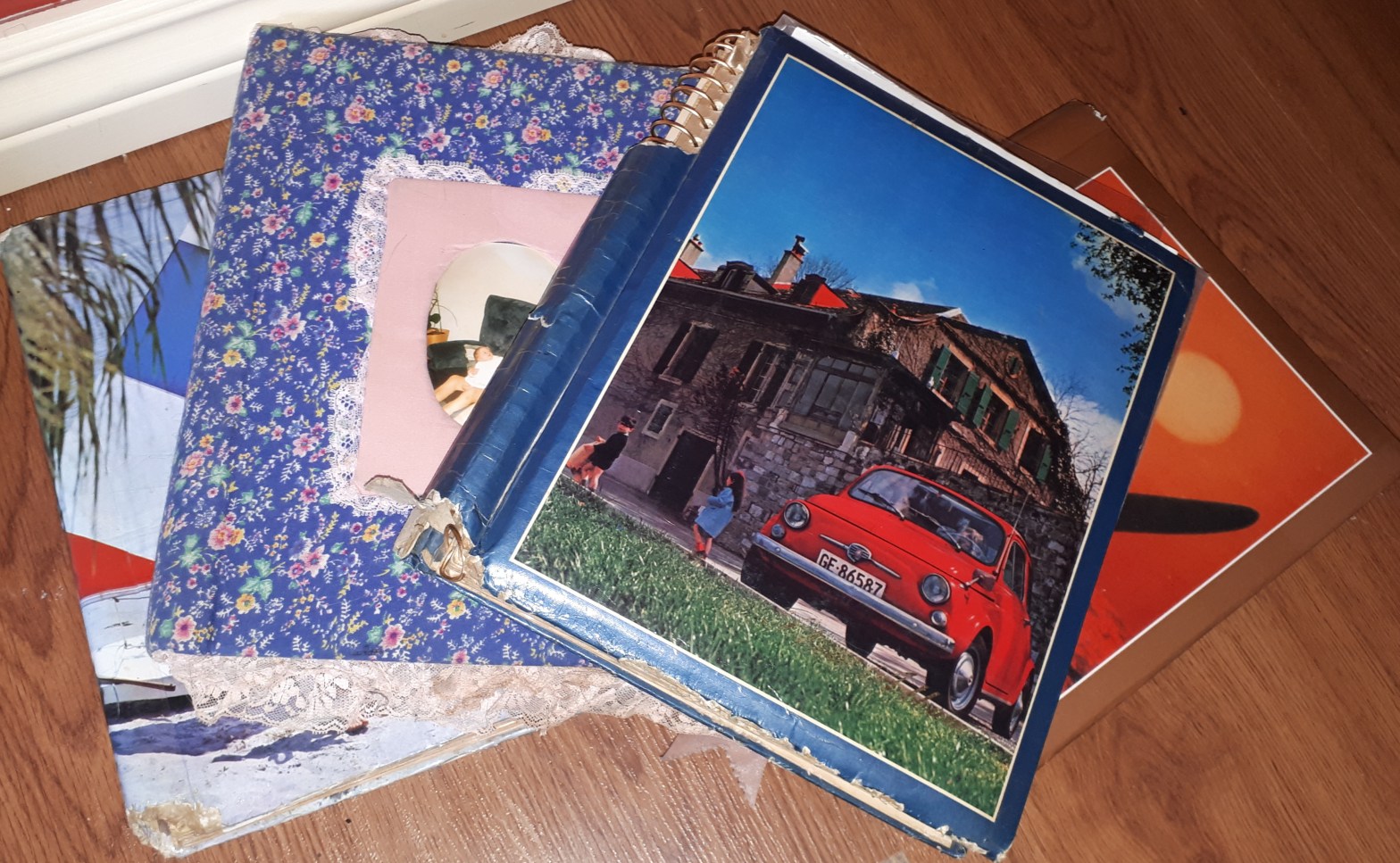
Let us hit the rewind button. Going back to a time before social media, and before internet was readily accessible. Back to a time when people had cameras that required film. A time where you couldn’t instantly review the photo you took, and you had to wait for it be developed. You had to pay for film itself, and for it to be developed, and you only had a limited number of shots in that film. A time when people commonly had photobooks or photo albums.

In this time, the focus of taking photos was to capture a memory. A memory of an event, of a person or people, or of a place. When people brought out photos or photo albums, it came with stories. Stories of events, people and places. The person sharing the photos or telling the story would connect with their memory, and invite those looking at the picture to join with them. It was a way of connecting. Was there an element of people wanting to look good in the picture, or get a good photos? Yes, and there was also the memories and stories to be told.

What would it be like to go retro with how we look at the photos we have, and maybe those that we take? When scrolling through social media, or stumbling upon photos in a phone or computer, I wonder what would happen if we focused on the memories. When was the photo taken? Where was it taken? What was happening (in the photo and at a broader level)? If we were showing this photo to someone, what would the story be or the memory that we would be sharing? What would happen if we took the focus away from how perfect or not perfect we look?

What would it be like to go retro with how we look at the photos we have, and maybe those that we take? When scrolling through social media, or stumbling upon photos in a phone or computer, I wonder what would happen if we focused on the memories. When was the photo taken? Where was it taken? What was happening (in the photo and at a broader level)? If we were showing this photo to someone, what would the story be or the memory that we would be sharing? What would happen if we took the focus away from how perfect or not perfect we look?

I invite you to experiment with going for the memory or story, and connection with others through these in your photos, and move away for the appearance.

Be the Change You Want to See in the World

Body image struggles are rampant. Each day people look in the mirror, and pick apart their appearance and all the ways they are ‘not good enough’. For some their focus is on their weight or shape, for others their focus may be their age, or masculinity or femininity, or race or ethnicity.

Yet, this has all been learned. Throughout our lives we have been exposed to countless messages about what appearance is ideal. Messages about appearance is associated with success, acceptance, love, control, or worth. These messages didn’t just exist in our childhood, and society has since changed. The messages in society that play a role in creating and maintaining body image struggles still exist, and are everywhere. But what if we could do something to disrupt that?

Below is an audio file that guides you in connecting with a world where appearance is less important. Judgments based on appearance are not held tightly, and do not hold as much power over peoples actions. Listen to the audio.

Once you have listened to audio, write down or mentally note, what did you notice was different in that world?

Then, take a moment to think, and write down, something that you can do today, this week or this month, that would move you closer to that world. or example: Some people noticed that in that world their interactions moved away from people’s appearance, and more towards the person as a human with thoughts, interests, likes and dislikes. A step towards that world that they decided to try to take, was to connect with others at that level, and steer away from appearance based conversations.

Then, actually do that thing, and maybe more. Let us create a world where there isn’t as much importance or judgment placed on appearance.

The Fear Armour

I fear being judged. In particular, I fear people will think I’m stupid, incompetent or boring. I fear that they will come after me with hurtful comments or stab me in the back. These are things I have experienced, from my childhood and adolescence, all the way to recent years. I’ve experienced judgment and hurtful actions in my personal life, and in my professional life.

So how have I handled those fears? What have I done? I have avoided a lot. I artfully doodged (or so I thought) different activities and environments where I have felt more vulnerable to the judgement, whether it is the environment or activity itself or the people around me at the time. I have adjusted what I have said based on what I have thought the others want to hear. I have waited for someone else to take the lead, and then followed. I have sat in silence. I built an armour around me.

You know what happened as I did that? I got further away from me. The me that was fun, smart, funny, creative, and a bit of a badass. As I got further away from me,  there were times where I would be confused about was is me and what was my armour. The glimmers of the smart and creative me would come forward in brief flashes of ideas, but they were never acted upon. The armour was immobilizing me. Life got more dull and listless. Connections with people more empty, because it wasn’t me they were connecting with.

But I care about people. I care about my connections with people. I care about being good at what I do, because I care about my clients and the field I work in. I care about experiencing the world and all it has to offer. I got anxious and scared because I care. Negative judgement from others, and actions they may take based on those judgements, threatened what I care about. But in putting all that armour on to protect myself from being seen and judged, I prevented myself from being seen and loved (by myself included).

So I started to shed the armour, in service of the things I care about. Is it scary to shed the armour piece by piece? Yes. Yet as there is discomfort in fear and vulnerability, there has also been comfort in being seen and loved for me. To be heard, and liked for my words and thoughts, not for what I think people want to hear. I still have my fears. Yet I stand with less armour, with anxiety and with excitement. I can move without that heavy armour and I want to see just how much I can move. I am fun. I am smart. I am funny. I am creative. I am a badass.

This piece of writing was inspired by the following webinar, Facing Fear and Shaping Bravery

Weight Stigma and the Obesity Epidemic

In recent decades people’s weight has gotten higher and higher, leading to what many call an obesity epidemic. Given the amount of health issues attached to obesity it made sense that people felt a need to respond, and respond quickly. Unfortunately the call to respond has not only missed its mark, but has impaled a lot of people along the way.

How did we respond to the obesity epidemic?

As the research indicating the negative health impact of being overweight or obese mounted, attention was drawn to peoples size and the need for change. There was almost an unspoken assumption that if you draw people’s attention to weight and shame them, that it will motivate them to take steps towards losing weight. In the messaging, there was also an oversimplification of weight gain and weight loss, which created a high sense of personal responsibility and ease to addressing weight.

What did this create?

Even prior to the obesity epidemic there were a number of assumptions and associations attached to weight that were negative, but the obesity epidemic and response to it expanded and magnified the associations and assumptions. Weight as a health concern morphed into a person who is overweight being perceived as bad, weak, lazy, etc. This movement seemed to give people permission to comment or treat people who are overweight or obese in a negative way under the guise of ‘it is in their best interest, they need to lose weight for their health’.

Weight bias is negative attitudes and views towards people because they are overweight or obese. When these negative views expand forming negative assumptions and stereotypes (i.e. thinking people who are overweight are lazy, and lacking willpower or control) impacting a person’s actions (including prejudice, rejection and discrimination) it is known as weight stigma. Weight stigma is very prevalent, and has been observed in multiple domains, including; family, friends, employment, education, and healthcare. Sadly, weight bias and stigma emerge at a very young age, as captured in research observing that children as young as 3 years old attach negative attributes to obesity (i.e. overweight children were labeled as being ‘lazy’, ‘stupid’ and ‘ugly’). While there is increased experience of weight stigma by those who are overweight or obese, it is experienced across most weight categories. It is believed that weight bias and stigma has been increasing over the past few decades.

Impact of weight bias and weight stigma

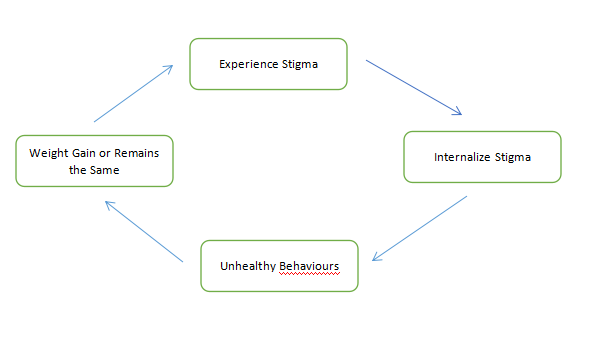
After being repeatedly exposed to weight stigmatization it is not unusual for a person to start to identify and agree with the negative stereotypes and judgements attached to weight, and apply those labels to themselves. This is known as internalized weight bias or internalized weight stigma. This internalization occurs not only in people who are obese or overweight, but also in those who are in a healthy weight range. The internalization of stigma results in thoughts and feelings of worthlessness, incompetence, self hatred, shame, guilt, and incompetence. People who experience internalized weight stigma are more likely to experience depression, anxiety and disordered eating, low self esteem and lower quality of life. Research has also indicated that as a result of experiencing and internalizing weight stigma they are also less likely to engage in health related behaviours (such as physical activity), and more likely to engage in unhealthy behaviours (such as over eating). This creates a viscous cycle of experiencing weight stigma, leading to internalization of stigma and uncomfortable thoughts and feelings, which leads to difficulties in engaging in healthy behaviours and more likely to engage in unhealthy, which in turn may lead to weight remaining the same or weight gain, and the experience of further stigma.

Weight Stigma Cycle

So the response to the obesity epidemic not only isn’t effective, but may be making things worse.

Where did we go wrong?

The intent of wanting people to be healthy is not a bad one, so where did things go wrong? If we return to the initial response to the obesity epidemic there are a couple of glaring assumptions that are incorrect, and potentially harmful.

The first unhelpful assumption is that shaming leads to change. Research has indicated this approach does not lead change, not only in relation to weight but also other areas (such as addictions). Shame and shock based interventions tend to increase a person’s level of distress, which often drives the person to the behaviour that the intervention is trying to target. As the behaviour may be a person’s way of coping with distress, it makes sense that they would move towards it when distressed, even though a part of them may know it is unhealthy or not helpful.

The second assumption commonly made in relation to the obesity epidemic are assumptions around the ease of weight loss and weight gain. Weight loss and weight gain is actually pretty complex, and involve a mix of interacting physiological (including genetic) and psychological processes. When these processes get oversimplified, people perceive weight loss as easy and being at a higher body weight and weight gain is perceived to be purely related to poor intake and low activity. This in turn leads to further assumptions and judgments, leading a person further down the path of weight stigma.

Where to from here?

The metaphor of ‘carrot versus stick’ to lead a horse, or the proverb of ‘you catch more flies with honey than vinegar’ may be helpful to keep in mind. For change to happen, weight stigma and shaming in society needs to come down, as does the internalization of weight stigma. The prevalence of both of these (stigma in society and internal stigma) make this quite a challenging task, but as individuals we can take steps to help create change. Here are some things that can be done:

  1. Remember that shaming does not lead to change, and weight can be a complex issue.
  2. Become more aware of weight stigma, and take steps to interrupting it. This may involve you noticing thoughts, assumptions and actions you have about weight, and exploring ways to do things differently at an individual level. It may involve noticing weight stigma you may see around you, and starting conversations that get people to pause, think and maybe even change.
  3. Increase understanding and compassion, not only towards people who may be victims of weight stigma but people in general.
  4. Be aware of how you speak about body and weight, particularly around children. From a young age connect with kids for who they are, and encourage them to do the same with other children. Steer them away from negative labels and assumptions.
  5. If you struggle with internalization of weight stigma, be kind and compassionate to yourself, lower the shame. Return the focus to who you are as a person and the life you want to be living, and take small steps towards this.

These are just some initial steps. The obesity epidemic and the weight stigma epidemic that is following it, are complex issues that won’t be solved over night. Yet we can move towards being kind, compassionate and understanding towards each other as we try to find our way through these complex issues.

Why Do I Do That?

A common experience people have as they enter therapy is this sense that there is something wrong with them, and that they alone have the experiences they are having. Not only are they distressed by their internal experiences, but they feel alone in them. They feel that these internal experiences are indicators that they are really messed up.

What is really interesting is that many of those experiences that they bring, are experience that everyone (including their therapist), has had. The reason why it is a shared experience or common experience is because our brains are wired that way. The structure of our brain has not changed much in thousands of years. So, as much as the world around us has changed a lot over the years, our brains have not. Our poor brains are trying to apply the same old system to an increasingly stimulating and complex world, and as a result of that we encounter difficulties. Here are just a few of the more common ones:

  • Always Jumping to the Negative

Take your mind to the time of our ancestors. Imagine two tribes. One tribe doesn’t tend to jump to the negative. If they heard a rustle in the bushes they may have thoughts of ‘Oh it is probably nothing, just the wind’ or ‘Maybe it is a rabbit’ or ‘Maybe it is a family member’. They don’t pay much attention to the noise. They may notice the temperatures getting colder and it getting darker, and think ‘It probably won’t get too cold. It was warm yesterday, so I am sure we will be fine’. They carry on as usual.

The other tribe, does tend to jump to the negative. So when they heard a rustle in the bushes they thought it was a predator, and would ready themselves to fight or flee. When they noticed changes in light and temperature, they got worried because the last time they saw such changes, winter came and resources became scarce. So they started to gather and stockpile food. Which of these tribes would be more likely to survive?

The mind’s ability to notice and anticipate the negative enabled our ancestors to take action to protect themselves. It kept them alive. So, that tendency to jump to the negative comes from the protective place in our brains.

  • Compare Myself to Other People

Again, if we go back to the time of our ancestors, they lived in groups. Groups allowed for the sharing of workload and resources. Being in groups assisted in protection and procreation. If a person’s actions brought threats or harm to the group, a person would face being kicked out. Once out of the group, if they did not then find another group, they would likely perish.

Imagine being placed in a group with your ancestors, how would you know what the group needs, or what is acceptable or not acceptable within the group? You would watch the other group members. You would notice what they are doing and how others in the group respond. You would compare that with your own actions, and adjust accordingly. So if a particular action seemed popular in the group, you may seek to recreate it or build on it. If an action was not favorable, you would steer away from it.

We still have that wiring in our brain. So it is not unusual to look to others to compare to see where we fit or don’t fit. It also explains why we can have intense emotional experiences in social situations because our ancestral brain interprets rejection from group as being very dangerous. But our social world is WAY bigger and more complex than our ancestors. Chances are you have more people on your social media than what your ancestors had in their groups. You are also likely to be making comparisons across multiple groups, and thus encountering different, and at times conflicting, norms.

  • Never Feel Good Enough

Everyone has an inner critic. The inner critic is kind of a combination of these first two points- it is the negative mind often unfolding in a social comparative context to create a sense of not being good enough. The inner critic wants to help. It wants you to do better, but often its way of trying achieve this isn’t effective.

  • Feel Emotions

I am going to come back to this one in a longer post later. There is a lot to this one, but I am going to put it in ridiculously simple terms here. As much as at times we may think that life would be so much easier if we didn’t feel, our emotions have a purpose. Just like our senses alert us to danger that we can then respond to, so do our emotions. Our emotions draw our attention to things we may want to move towards or away from. Here are a few emotions, what they are alerting us to and the movement they can create.

  • Fear: alert to danger, and moves away from threat
  • Anger: alert to danger or pain, and moves us away from danger or pain.
  • Sadness: reaction to loss, and moves us towards replacing what is lost.
  • Guilt or shame: alerts us to action that runs against what may be important to us or our group, and moves us away.
  • Disgust: alerts us to something we don’t want, and moves us away.
  • Happiness: alerts us to something we enjoy and moves us towards.

The other thing with emotions is, if you didn’t care you wouldn’t feel. If something isn’t important to you, you are not going to worry about whether it will go away, or be angry if someone takes it, or sad it is lost, or happy when you get it. It is impossible to get rid of the dark without also getting rid of the light.

Acknowledging that these processes are normal and a product of our wiring helps remove some of the self judgment and sting that often comes with them, and enables you to look at and respond to them differently. Maybe with a little more compassion, kindness and understanding.

Are we Misattributing an Agent of Change? Impact of a Weight Assumption

I have seen so many shows, articles and posts, all claiming how a person’s life changed because of changes in weight. The stories create an image of a person being like an ugly caterpillar unwanted by the world, who with weight loss turns into a beautiful butterfly, whose life completely changes in every way. We assume that weight is the only agent involved in change, or the necessary catalyst, whereby the other joys and gains can’t happen without it. But what if that assumption is incorrect? What if there are changes at a thinking, feeling and behavioural level that happen along the way are the main agents, but instead we attribute it all to weight?

I recall watching one of those weight loss shows, probably a decade ago, and a contestant stood out to me. He became one of the fan favourites, and he reported that he was a whole new person because of his weight loss journey. While I didn’t doubt that he changed over his journey, I did wonder if the changes he experienced were being portrayed in an oversimplified way (shocking for a television show to do that, I know). Of course I noticed there was a change in his weight from start to finish, but I also noticed that the way he interacted with people completely changed. At the beginning he would not make eye contact or chat with people, and at times seemed angry. Along his journey he started to make eye contact with people. Started to smile. Started to engage in conversation and show aspects of his personality. As he did so, people approached him more and talked to him, and this positive feedback lured him out more. While weight loss may have assisted him in being able to make that change in interaction, I remember wandering what would have happened if he had engaged in those changes without the weight piece. Would he have experienced the same reinforcing feedback? or would society stay so stuck in it’s weightism, and force him back into having to retreat?

If we make the assumption that significant positive change both physically and mentally is because of changes in weight, it makes sense that weight loss is celebrated and praised. It also makes sense that other assumptions are derived from it, including; weight loss is good, weight loss is an indicator of other positives, and then conversely weight gain is bad.

So what? You may ask. Well, an assumption involves jumping to conclusions based on limited information, and thus there is a margin of error. A fair bit of hurt and destruction can occur in that margin of error in relation to weight assumptions. Imagine being in the following situations;

  • You have seen someone that you haven’t seen for some time. They appear to have lost weight. You have thoughts of ‘wow, good for them!’, and your comments and interactions flow from that. But you later find out that the weight loss you observed was due to something else, such as a physical health issue, an eating disorder, stress, or a mental health issue creating loss of appetite.
  • You have lost weight, but also had a number of other things happen in your life (good or bad), yet all anyone talks about is your weight.
  • You are watching other people respond to a person who has lost weight with praise. You remember the last time you saw that person, you were roughly the same size as them.
  • You are a young teen, increasingly becoming aware of your body, and are watching your parents and their friends interact. You notice that they are talking about their own and other peoples bodies, praising weight loss and negatively judging weight gain.
  • You decide you want to lose weight in the hopes that in doing so, other changes will follow. But in your journey, nothing else changes. The challenging emotions remain, and your self confidence doesn’t move much.

As you put yourself into each of these examples you may notice some of the assumptions appear, and further thoughts and feelings flow from there. Going back to each of those situations, here are some of the thoughts and feelings that may occur that are connected to the original assumption of weight loss as catalyst for positive change;

  • The person who is being praised for the weight loss, that was actually due to something else may feel awkward, and you upon finding out the reason for the weight loss may also feel awkward, and maybe even guilty or embarrassed.
  • In the situation where you have lost weight, and had a number of other things happen in your life aside from the weight, you may become disappointed and frustrated by the constant redirection to weight. If it were challenging things that were happening, you may miss out on getting support, and if it were positive things, you may miss out on fully celebrating them.
  • In the situation of previously being the same size as the person who has lost weight, your mind might move beyond the weight piece. You may have thoughts of ‘they are happier than me’, or ‘they have got their life put together better than me’.
  • As a teen, you might look at your body and compare to those who are having the conversation. Pending where your body lands, you may put yourself in the ‘need to lose weight’ category, and you may have thoughts of ‘what are others thinking about me? Are they talking about me in this way?’.
  • In the situation where you lose weight but the other changes don’t happen, you might have thoughts of ‘this isn’t working’, ‘need to lose more’ or ‘there must be something wrong with me’.

As you can see in these examples, the knock on effect of the assumptions attached to weight can be negative. Pending the individuals involved and how they respond to the thoughts and feelings that are evoked, further negatives may follow. Our minds will make assumptions. That is what our minds do. At times assumptions can be helpful little shortcuts. But at other times our actions based on the assumptions can be problematic.

So as we gather (in line with any COVID restrictions of course) be aware of your responses to changes in peoples appearances. Try to stay away from assumptions or making the interaction completely about weight. As we move towards New Years, and the inevitable discussions around New Years resolutions, if you are making a resolution around weight, pause and think- why am I making this resolution? Are there any assumptions driving it, of ‘once I lose weight…’? This is not to take you away from your desire to lose weight, but rather connect with what drives it, and use that as an area for action or measurement. For example, if your desire for weight loss comes from a place wanting to improve health or strength, maybe focus on other measures of health (i.e. improved cardio ability) or strength (i.e. increasing weights).

There is so much more to all of us than just weight. Let us create an environment where those other qualities can shine brighter.

Get Back to Basics this Holiday Season

Take a moment, and think about some of your most cherished memories of the holiday season. Not just a split second of thinking before continuing on reading, really take a good few minutes to think about some of your favorite memories, and what made them so special and memorable. I can wait while you take your time to do that.

I don’t know about you, but for me my favorite Christmas memories were all about the special people in my life. My favorite memories have nothing to do with what myself or my loved ones looked like, or how much money they spent or had, or whether or not everything was just perfect. They are moments of laughter (like the family witnessing the beloved Christmas turkey catching fire, a story that we all share and have laughed over ever since). They are moments of sadness (like being with loved ones for what you know will be their last Christmas, or celebrating Christmas with those who remain and all sharing the grief of that special one not being there). They are moments of surprise (like surprising a family member with a Christmas visit to Australia, all the way from Canada). They are moments of just being with people while they can authentically be themselves and loved for just that (like singing carols by candlelight or sharing family stories of Christmas past).

Hold onto those past memories and what made them special when thinking about what you want this Christmas to be about. Not social media or media in general or what others may think. Take another moment now, What meaningful memories do you want to create this year? What memories could be a bright light after the mess of 2020?

Whether you are able to be with loved ones, or are kept a part because of COVID or other reasons, make sure you tell the people in your life that you love them. You never know if this Christmas will be their last or when you will see them next. In this year of disconnection it can be easy to forget that the love is still there, so it is even more lovely to hear that people care.

Be kind. Be authentically you. May you have many beautiful memories this holiday season!

We Need to Change the Dialogue

In the work I do, personally and professionally, I talk a lot about and connecting with values and what is important. In a previous post I encouraged people to reflect upon what they identify as making a person ‘good’ in different roles (i.e. what makes a good parent, or good partner or good friend?), to draw attention how the things that are important to us, are often not related to weight (despite what our minds tell us).

Yet the dialogues that happen around us, that we are a part of, impede us from feeling safe to connect with what is important, and in turn genuinely connect with the world and other people. Let us take a moment to think of different ways the dialogue moves towards weight, and away from values and away from creating safety.

Can you recall a time:

  • Where you, or someone you know, hadn’t seen someone for awhile, and one of the first comments they make to the person or about them is weight or body related (e.g. ‘you look like you have lost weight.’ or ‘I saw them the other day, and they have really put on some weight’). Here is a person who you haven’t seen in some time, who knows what struggles and successes they may have had in that time, and instead of talking about that the talk moves to weight. It sends a strong message of what is more important- weight is important, not what you have been through since I last saw you.
  • Where it is a time of celebration and connection, not surprisingly there is food at that time- as food is often how we celebrate and connect. Instead of talking about enjoying the food, the company and the event- the focus of conversation moves to the weight that may be gained during that time, or the diets a person will need to go on to compensate for what they just ate. Again, weight and diet is moved ahead of the people, connection and celebration.
  • Of New Years celebrations and the discussion moves to reflection and new years resolutions, and thus there is discussion around diet, exercise and weight. The success of year is marked by weight and food- not who a person is and the actions they have taken in that year.
  • There is a group of people talking, a person who is overweight speaks or tries to speak, only to be quickly cut off, spoken over or laughed at for what they said. The message of, ‘you don’t deserve to speak’ is conveyed.
  • A new person is being brought to a group (for example through dating, friendship circles or work) and all eyes move to their body. Later people ask about their thoughts on the new person, and the conversation moves to their weight. Again the message is their weight matters more than who they are as a person.

Some or all of those instances may be familiar to you. You may recall many more that convey similar messages. You may have been hurt by the actions, or you may have been the one driving the conversations. If you were hurt by these kinds of these situations, I send you warmth and compassion, and hope that the experiences didn’t stop you from being you. If you were the one driving the conversations, be gentle on yourself, we have been conditioned to respond in that way and we can always change.

How do we change? That is a hard one to answer, as the context and type of interaction may impact what you can do. If you are someone who usually starts the weight or diet based conversations, please try to refrain and instead move towards other topics of conversation. Show curiosity. Ask what is happening in the person’s life or move the discussion to what they are interested in or shared interests or current affairs or shows/movies or books.

If these styles of interactions are happening around you, you could directly challenge them, or say you don’t feel comfortable with that conversation, or gently divert the conversation away from that topic, or remove yourself from the discussion. Sometimes it is not possible to confront nor change what is happening, and if this occurs, do the next best thing- reach out and connect with the person(s) who may have been hurt by such an interaction. Not out of pity, but out of solidarity. Out of wanting to let them know that they matter, not because of how they look but because of who they are.

Move your interactions towards connecting with people for who they are, and if you aren’t sure who they are, then ask. Find out what brings them joy and lights them up, and connect with that. Everyone has a unique story to tell and something special to give, they just need a space where they can feel safe enough to shine. So let us join together, change the dialogue and create a space to shine.