
In recent decades people’s weight has gotten higher and higher, leading to what many call an obesity epidemic. Given the amount of health issues attached to obesity it made sense that people felt a need to respond, and respond quickly. Unfortunately the call to respond has not only missed its mark, but has impaled a lot of people along the way.
How did we respond to the obesity epidemic?
As the research indicating the negative health impact of being overweight or obese mounted, attention was drawn to peoples size and the need for change. There was almost an unspoken assumption that if you draw people’s attention to weight and shame them, that it will motivate them to take steps towards losing weight. In the messaging, there was also an oversimplification of weight gain and weight loss, which created a high sense of personal responsibility and ease to addressing weight.
What did this create?
Even prior to the obesity epidemic there were a number of assumptions and associations attached to weight that were negative, but the obesity epidemic and response to it expanded and magnified the associations and assumptions. Weight as a health concern morphed into a person who is overweight being perceived as bad, weak, lazy, etc. This movement seemed to give people permission to comment or treat people who are overweight or obese in a negative way under the guise of ‘it is in their best interest, they need to lose weight for their health’.
Weight bias is negative attitudes and views towards people because they are overweight or obese. When these negative views expand forming negative assumptions and stereotypes (i.e. thinking people who are overweight are lazy, and lacking willpower or control) impacting a person’s actions (including prejudice, rejection and discrimination) it is known as weight stigma. Weight stigma is very prevalent, and has been observed in multiple domains, including; family, friends, employment, education, and healthcare. Sadly, weight bias and stigma emerge at a very young age, as captured in research observing that children as young as 3 years old attach negative attributes to obesity (i.e. overweight children were labeled as being ‘lazy’, ‘stupid’ and ‘ugly’). While there is increased experience of weight stigma by those who are overweight or obese, it is experienced across most weight categories. It is believed that weight bias and stigma has been increasing over the past few decades.
Impact of weight bias and weight stigma
After being repeatedly exposed to weight stigmatization it is not unusual for a person to start to identify and agree with the negative stereotypes and judgements attached to weight, and apply those labels to themselves. This is known as internalized weight bias or internalized weight stigma. This internalization occurs not only in people who are obese or overweight, but also in those who are in a healthy weight range. The internalization of stigma results in thoughts and feelings of worthlessness, incompetence, self hatred, shame, guilt, and incompetence. People who experience internalized weight stigma are more likely to experience depression, anxiety and disordered eating, low self esteem and lower quality of life. Research has also indicated that as a result of experiencing and internalizing weight stigma they are also less likely to engage in health related behaviours (such as physical activity), and more likely to engage in unhealthy behaviours (such as over eating). This creates a viscous cycle of experiencing weight stigma, leading to internalization of stigma and uncomfortable thoughts and feelings, which leads to difficulties in engaging in healthy behaviours and more likely to engage in unhealthy, which in turn may lead to weight remaining the same or weight gain, and the experience of further stigma.
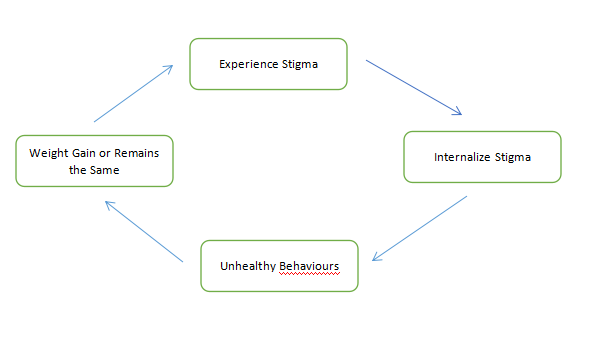
So the response to the obesity epidemic not only isn’t effective, but may be making things worse.
Where did we go wrong?
The intent of wanting people to be healthy is not a bad one, so where did things go wrong? If we return to the initial response to the obesity epidemic there are a couple of glaring assumptions that are incorrect, and potentially harmful.
The first unhelpful assumption is that shaming leads to change. Research has indicated this approach does not lead change, not only in relation to weight but also other areas (such as addictions). Shame and shock based interventions tend to increase a person’s level of distress, which often drives the person to the behaviour that the intervention is trying to target. As the behaviour may be a person’s way of coping with distress, it makes sense that they would move towards it when distressed, even though a part of them may know it is unhealthy or not helpful.
The second assumption commonly made in relation to the obesity epidemic are assumptions around the ease of weight loss and weight gain. Weight loss and weight gain is actually pretty complex, and involve a mix of interacting physiological (including genetic) and psychological processes. When these processes get oversimplified, people perceive weight loss as easy and being at a higher body weight and weight gain is perceived to be purely related to poor intake and low activity. This in turn leads to further assumptions and judgments, leading a person further down the path of weight stigma.
Where to from here?
The metaphor of ‘carrot versus stick’ to lead a horse, or the proverb of ‘you catch more flies with honey than vinegar’ may be helpful to keep in mind. For change to happen, weight stigma and shaming in society needs to come down, as does the internalization of weight stigma. The prevalence of both of these (stigma in society and internal stigma) make this quite a challenging task, but as individuals we can take steps to help create change. Here are some things that can be done:
- Remember that shaming does not lead to change, and weight can be a complex issue.
- Become more aware of weight stigma, and take steps to interrupting it. This may involve you noticing thoughts, assumptions and actions you have about weight, and exploring ways to do things differently at an individual level. It may involve noticing weight stigma you may see around you, and starting conversations that get people to pause, think and maybe even change.
- Increase understanding and compassion, not only towards people who may be victims of weight stigma but people in general.
- Be aware of how you speak about body and weight, particularly around children. From a young age connect with kids for who they are, and encourage them to do the same with other children. Steer them away from negative labels and assumptions.
- If you struggle with internalization of weight stigma, be kind and compassionate to yourself, lower the shame. Return the focus to who you are as a person and the life you want to be living, and take small steps towards this.
These are just some initial steps. The obesity epidemic and the weight stigma epidemic that is following it, are complex issues that won’t be solved over night. Yet we can move towards being kind, compassionate and understanding towards each other as we try to find our way through these complex issues.
 drsarahpegrum